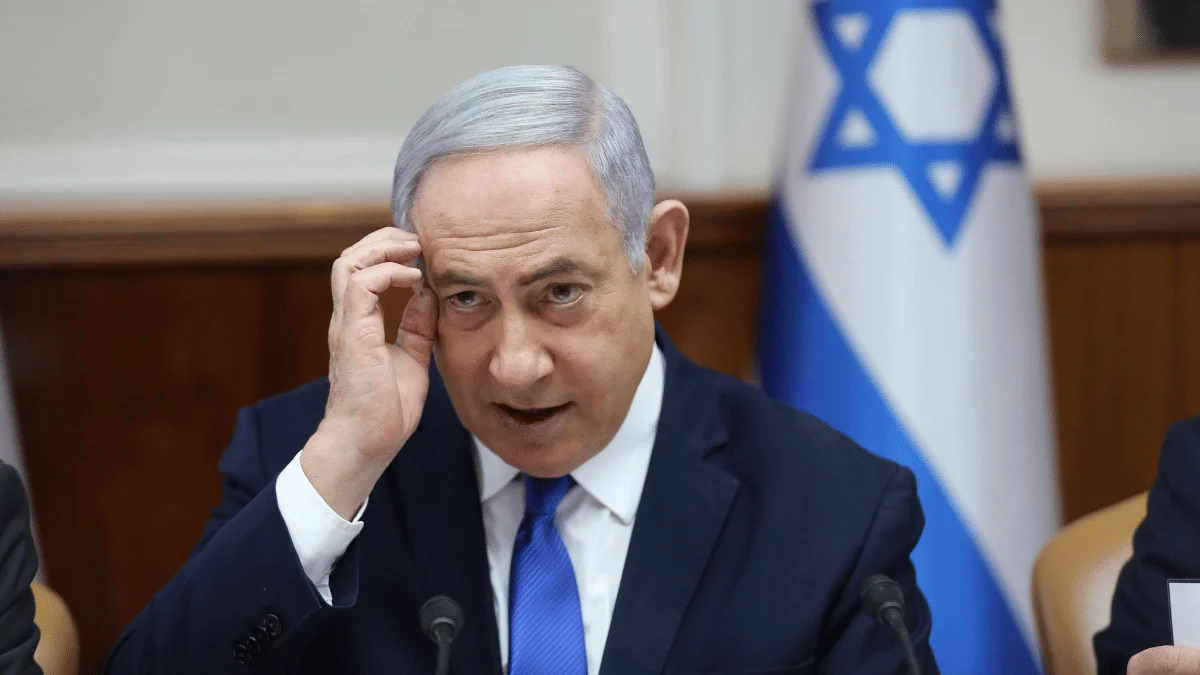
October 7, 2023 attack compelled Israel to wage a fierce war,” Benjamin Netanyahu said nine days before Israel’s elections, unveiling the country’s national security dialogue. It was the first time since the Hamas-led attacks that the Israeli prime minister had convened media at his office in Jerusalem for an in-person briefing on security issues. Netanyahu made a speech, showed maps, and displayed Israel’s success with him on the security front. It was neither routine nor an exception for Netanyahu. He was officially laying out the doctrine he had long adopted.
For Israel’s longest-serving prime minister, this election was not only about staying in power. It was also a referendum on his national security doctrine, especially after the 7 October attack and the wars he started on multiple fronts against ‘Israel’s enemies’.
The election is over. Neither of the coalitions won. None of them lost. But there is one clear winner: Netanyahu.
He may not have emerged stronger politically, but he has much to celebrate. He fought anti-incumbency, proved most of the polls wrong, and has now got a partial certificate from his voters. The future of government is uncertain, but one aspect has a definitive answer: it’s no longer a probability, but only a matter of time. The mandate will give him enough confidence to not only continue the wars against Hamas and Hezbollah, but also launch another attack on Iran.
He stands to gain in all scenarios that can play out for government formation, and there’s a high chance the 77-year-old will retain power. Thanks to the country’s complex politics, electoral process, and the anti-Arab sentiment that has amplified after the 7 October Hamas attacks, there are four possible ways the election can go.
If a unity government is formed, as US President Donald Trump envisions, Netanyahu will continue as the prime minister. Gadi Eisenkot will have to swallow his stance of leading the ‘bloc of change’—the main premise on which he founded his Yashar party, built a coalition, and won 48 seats. In this scenario, the anti-Netanyahu bloc will be seen as going back on the promises on which they secured their votes.
The second possibility is a fresh election. Netanyahu not only retains power for the next few months, but also gets an advantage. Israelis living outside the country, who flew in to vote for a change, are unlikely to return in such large numbers in six months to vote once again. The opposition bloc, as well as the Arab parties, are unlikely to repeat the kind of mobilisation they managed in the October election.
Another scenario on paper is Eisenkot joining hands with Arab parties. But the chances of this becoming a reality are negligible. The last possibility is Eisenkot forming a minority government after an agreement with Arab parties. Such a government is fragile in all countries. It would be even more so in a nation with deep dividing lines. In the 19 years that he has been in power, Netanyahu has brought down governments, won re-elections, and changed his coalition partners. He is no political novice.
Also read: Israel must now decide what kind of democracy it wants to be
Win-win for Bibi
Netanyahu failed to secure a majority, with his coalition receiving nine seats less than it did in 2022. But if there is one winner in the Israeli election, it is Netanyahu. His bet on anti-Arab sentiment and promises on national security have paid off. He has emerged stronger than what most polls suggested before voting, and he will negotiate with other parties from a higher ground. This vote is a thumbs-up for the national security doctrine he adopted after the 7 October attacks and the wars he initiated.
For long, Netanyahu has positioned himself as the only leader who can protect Israel and the Jewish people. He has branded himself as Mr Security. “If someone rises up to kill you, kill him first,” an ancient Jewish text from the Babylonian Talmud, is Netanyahu’s favourite quote, especially after the 2023 terror attacks. He said it when Israel eliminated then-Hezbollah chief Hassan Nasrallah in September 2024; at an event in June 2026 in the context of the US and Israel’s strikes on Iran; and multiple times since.
Ahead of this election, Netanyahu doubled down on his promises and image, and dismissed his political opponents as ‘Leftists’ who would endanger Israel’s security. As voting drew closer, his statements on security amplified. On Sunday, less than 48 hours before voting, Netanyahu posted an AI-generated picture of a nuclear blast in what appeared to be Tel Aviv, warning the voters that if they failed to elect a leader unable to stop Iran’s nuclear programme, it could lead to a ‘second holocaust’.
While his opponents’ campaign was focused on seeking accountability for the 7 October attacks and Netanyahu’s failure to prevent them, the Israeli prime minister focused on actions that followed 7 October, and his voters have rewarded him. He may not have come out as strong in this election as he did in the last one, but Bibi is the only person with a win-win situation on his hands. He has many reasons to feel validated about his national security doctrine.
Janki Dave is Editor (Operations) at ThePrint. Her X handle is @Janki_H_Dave. Views are personal.
(Edited by Prasanna Bachchhav)